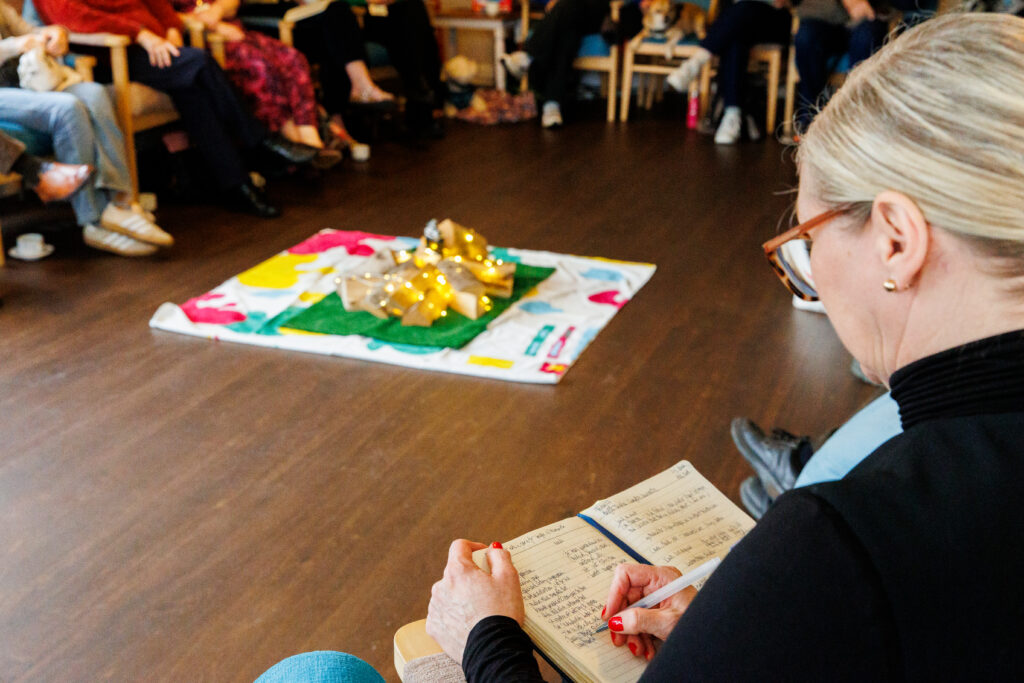
Campfire Conversation: Living and Dying Well Part I
Reflecting on our discussion of end of life dementia care with Pilgrims Hospices
image credit: Jen Holland
Dementia is the UK’s leading cause of death, but not everyone has access to the end-of-life care they need. In this article we reflect on our second Campfire Conversation, which explored the theme Living and Dying Well. In collaboration with Pilgrims Hospices, we explored what living well looks like at the end of life, what does and doesn’t support a good death, and what changes when we make ambitious art together. You can read about our first Campfire Conversation on Creativity and Connection here.
Why is end of life care for people living with dementia important?
This Campfire Conversation came about as part of a collaborative exploration of what we mean by end of life care in the holistic sense, beyond only medication. Bright Shadow and Pilgrims Hospices both have valuable experience working with people at the end of their life, and we wanted to begin a conversation about how together we can reach more people who need support in the community.
As Justine and Carrie from Pilgrims Hospices explained, the charity has 36 beds in East Kent and works with 1500 people in the community, supporting people to live as long and fulfilling lives as possible not only through planning and end- of-life advice, but also through creative groups and the arts. With that said, people with dementia might not see the hospice as somewhere they can go, as it is primarily associated with people with cancer in their very last days.
Likewise, using the power of the arts, Bright Shadow forges longstanding relationships with people living with and affected by dementia. We are very proud that our Zest groups welcome people at all stages of their dementia journey. People with dementia and their loved ones often attend Zest up until the end of their lives, and carers continue to attend Zest after experiencing bereavement. For those no longer able to attend group sessions, our Zest at Home programme brings professional artists directly to those in need, whether at home or in inpatient settings.
By working together to open a conversation about what living well at the end of life looks like for people with dementia, we hope to foster cross-sector collaboration, and develop and expand the bespoke support available for people living with and affected by dementia.
What do we know:
Tim Harrison, Artistic Director of We Live Here, Co-founder & Creative Director of Manchester’s SICK! Festival and Programme Lead for Medway Council’s Creative Health Place Partnership Programme, returned to host our second Campfire Conversation. Tim curated Dementia Journeys: Towards Better End-of-Life Dementia Care at London’s Science Gallery in response to the EMBED research project, exploring end of life and dementia care. Tim explained that the research found that people living with dementia need end-of-life care that:
Is more holistic
Is personalised
Meets physical, mental, social and spiritual needs
Includes more support for carers
Includes more intergenerational support
Is more holistic
Is personalised
Meets physical, mental, social and spiritual needs
Includes more support for carers
Includes more intergenerational support
We also know from experience within our community, including guests present at our Campfire Conversation, that end-of-life care for people with dementia often sadly falls short of these ideals.
What do we want to find out?
We planned this Campfire as a way to begin exploring:
What approaches could be developed to help people living with dementia with end-of-life planning
What options exist for end-of-life care?
What unmet needs are there?
How could we change perceptions of preparing for death? What does dying well look like?
What challenges do we face?
Through this conversation, we explored some of the challenges we face in improving end-of-life care for people living with dementia. A central theme of these challenges is fear: fear of death itself, but also of going into hospital, of clinicians, of uncertainty and of talking about death with those close to us.
Keith Oliver, NHS Dementia Envoy and Bright Times Reporter, said the most difficult conversations are with the people closest to him, and where once, when it seemed more abstract, it might have felt more possible to have conversations about death and dying, as death becomes more of a reality these conversations become harder and harder.
One clinician present shared that people often arrive at the Critical Care Unit without having had any conversation about their wishes. For him, a challenge is to encourage his team to connect at a human level with people in his care by reaching over the professional barrier and encouraging the sharing of personal stories that might help people make decisions.
As a group, led by members of the Pilgrims Hospices team, we explored the stigma attached to using services like hospices, and the relationship between this stigma and the fears of death and the medical system.
“We don’t talk about our feelings and we don’t talk about dying.”
Alison Culverwell, Chair, Bright Shadow
A community nurse shared that her team is working to support the very people who would benefit from such further support but due to time constraints and referring restrictions there are missed opportunities to connect people to services.
These challenges are cumulative, and result in a hidden population of people living with dementia in the community who are isolated – itself a risk factor – and unable to access the quality provision on offer from organisations including Bright Shadow and Pilgrims Hospices. This results in a further challenge of reaching people in need with quality interventions in a timely manner.
What tools exist to address them?
There was a strong sense in the room that fostering increased collaboration would improve outcomes all round – from improved care for people living with dementia to reduced NHS burden through reduced isolation and crisis. Tools for collaboration already exist:
Integrated neighbourhood teams
KCC prevention framework
Hythe neighbourhood health pioneer project
Primary care networks
Social prescribers
Integrated neighbourhood teams
KCC prevention framework
Hythe neighbourhood health pioneer project
Primary care networks
Social prescribers
By focussing on the person behind the medical condition, conversations about living and dying well can be facilitated. This led to a conversation around the value of the arts in facilitating these conversations. Several themes emerged:
Justine from Pilgrims Hospices highlighted that creative activity signals a relaxing of barriers, allowing people to relax into themselves. “When hands are engaged in creativity, mouths can talk more freely.”
Artists create space for people to express themselves and their wishes fully. They meet the whole person where they are.
Making things creates a lasting legacy, empowers people to be in charge of how they’d like to be remembered, and opens conversations about future wishes.
Artists hold on to those threads so that people can weave them back together, but also discover new things, removing the fear of failure by holding the whole person.
Justine from Pilgrims Hospices highlighted that creative activity signals a relaxing of barriers, allowing people to relax into themselves. “When hands are engaged in creativity, mouths can talk more freely.”
Artists create space for people to express themselves and their wishes fully. They meet the whole person where they are.
Making things creates a lasting legacy, empowers people to be in charge of how they’d like to be remembered, and opens conversations about future wishes.
Artists hold on to those threads so that people can weave them back together, but also discover new things, removing the fear of failure by holding the whole person.
“We were shocked that Dad loved Zest – we knew he liked doing arts activities with the kids but we hadn’t expected this. I wonder how many other people would feel activities are not appropriate, affordable or accessible for them?”
Al, artist and participant
“I think people get the wrong impression about the arts and creative activities and think ‘that’s not me’. We hear too much in the media that people living with dementia are less than – we’re losing all the time – but we’re still here! Until we’re not living anymore we should be treated that way. We may not be able to communicate or remember any more but creative arts for me is the best way to hold on to you as a person.”
Gill Ashington, Photographer, NHS Dementia Envoy, Bright Times Reporter and Bright Shadow Trustee
We discussed that the arts might not be for everyone and acknowledged that many of the people in the room are already actively involved in the arts and convinced of their multifaceted benefits. While it is true that conventional arts activities may not be of interest to everybody, we discussed why artists themselves – of any discipline – are well suited to working with people at the end of their lives.
Bright Shadow Associate Artist David Leahy shared the story of Zest at Home sessions he ran with S, who had in his professional career overseen large infrastructure projects. Because improvisation is at the core of David’s practice, he was able to hold space for S to come back to himself during a period of worsening symptoms.
An important feature of my sessions with S were conversations about trains, spurred on by his long career overseeing large infrastructure projects. The conversation regularly took on a business-like tone as we continued to assemble and dismantle the pieces of wooden railway that I had brought with me. Occasionally, I would place a guitar or drum on top of our construction site for S to play. He may balance trains or tracks on the strings, and we would listen to what sounds emerge. Together we would discover subtle little sounds that draw us both into deeper listening. Regularly, I would underscore S’s voice on the bass guitar, matching the pulse of his speaking with a bass line. He would then pick up the rhythm and tap along before starting to whistle a melody. I would then take up his melody and start to sing a small refrain. In this way, our musical journey would meander in, around, and through our conversation.
In this way, we can see that beyond leading arts activities, artists can have an unusual ability to be present with people, exploring what makes life meaningful for each individual. Indeed, artists can be highly responsive and improvisational in their approach, which is especially important for people living with dementia. In acute settings, things can start to go wrong when pressure results in a drift from person-centred care. When people are unable to verbalise pain through speech, for example, people providing care need to listen for non verbal cues. Artists can be particularly adept at modelling just this type of attunement.
Collaboration
Throughout our conversation, we focussed on living well at the end of life, and reducing anxiety and uncertainty around what will happen and what support is available. Pilgrims Hospices offer dedicated support to planning for death, as well as creative support at the end-of-life, and again the problem of signposting, the limitations of social prescribing, and difficulty navigating information, particularly for people living with dementia, came into view.
In this way, a key theme emerging from the conversation as a whole was the importance of collaboration between arts, health and social care, releasing profound personal and organisational knowledge from its silos and creating more joined up provision for everybody in the community. Some of the infrastructure for collaboration exists already in the form of integrated neighbourhood teams, primary care networks and social prescribers (discussed above) if only creative health practice can be embedded into it.
What next?
Throughout our conversation, we explored barriers to making change that would enable people living with and affected by dementia to feel more certain of the future. For more connected, holistic provision, we imagined the arts – and creative thinking – as a catalyst to make this change, following models like The Hera Project, where the arts are embedded in NHS provision. Everyone present, including Consultant Community Geriatrician and Clinical Lead for Kent Community Hospitals, Dr Philip Brighton, were very positive about these integrated approaches and the role of the arts in facilitating them. Our next steps are to reach wider audiences with these ideas, both commissioners and people living with dementia, and welcome them into a more collaborative approach.
Through this initial, broad conversation, we developed a second, more intimate Campfire Conversation to explore what people living with dementia need to live well at the end of life in more detail. You can read more about this here.
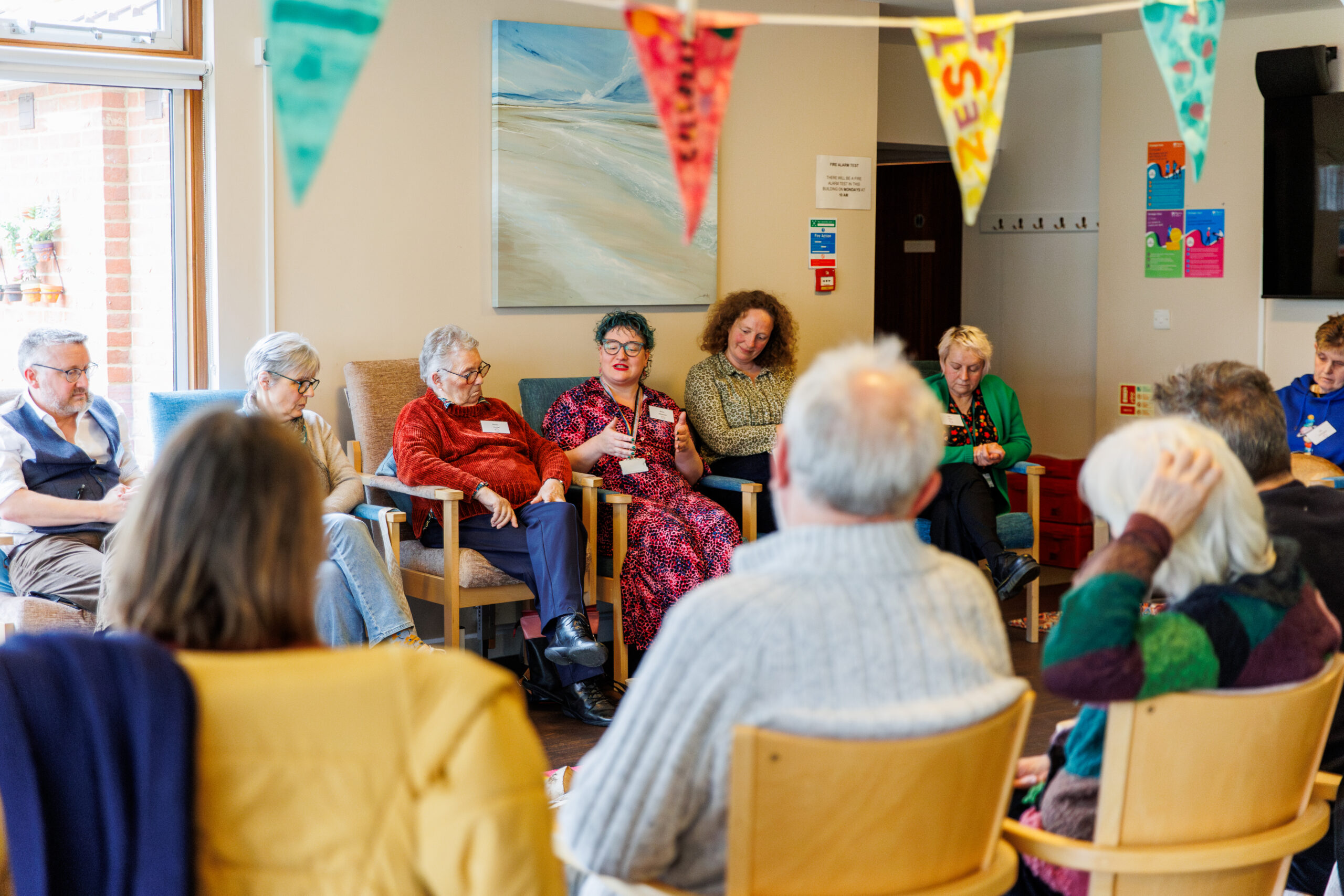 image credit: Jen Holland