Two of Our Trustees Share Their Stories
“Bright Shadow has the potential to make huge differences to the quality of life of many people affected by dementia. Everyone’s potential can be reached with the right support and backing.”

Two of our trustees, Gill Butchard, carer, and Rasa Mikelyte, researcher, talk to us about their relationship with Bright Shadow.
“So many people with dementia get a diagnosis with no contact and no medical support. They don’t know who to turn to. There’s a huge amount of reading material for which you have no time, or, if you have, you are struggling to understand it all. It’s completely overwhelming – even as a carer – so I really can’t imagine what it’s like if you’re on your own. You’re in the wilderness. For me, Bright Shadow was a beacon of light in that wilderness.”
Gill Butchard, Carer and Bright Shadow Trustee
Our conversation with Gill Butchard, Carer and Bright Shadow Trustee
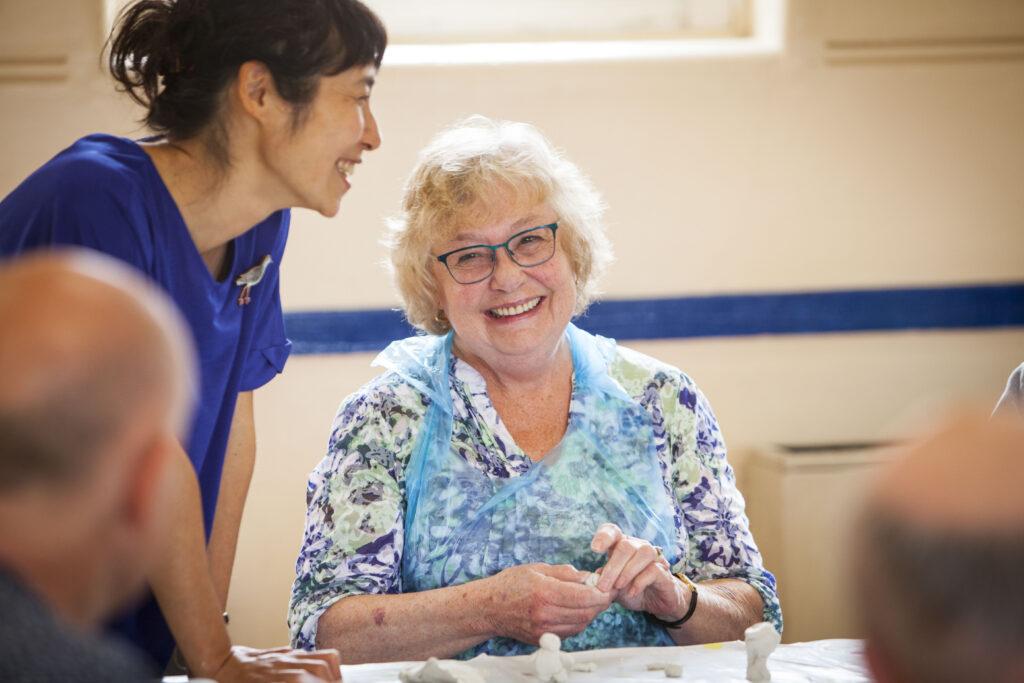
“It was a complete accident that I found them. I was in a coffee shop in Whitstable when I overheard some words in a conversation at the next table. I did something that I’ve never done before or since. I went over and said “Excuse me, did I hear you talking about “dementia activities?” I wanted to do something with Rob, my husband, together, not farming him out to a day centre where he didn’t want to go. He wanted to be with me, but I was exhausted. Trying to keep him stimulated was really difficult. His language was limited. What do you do to take them out of the house and feel like you’re part of the wider community? How many coffee shops can you go to? Going to Bright Shadow’s Zest sessions made a huge difference to both of us. Neither of us saw ourselves as “artistic” or “creative” in any way, but Rob responded positively. They were really stimulating for him and supportive for me. And I see that in the other participants too now. You come in feeling low and you leave on a high.”
Our conversation with Rasa Mikelyte, Researcher and Trustee
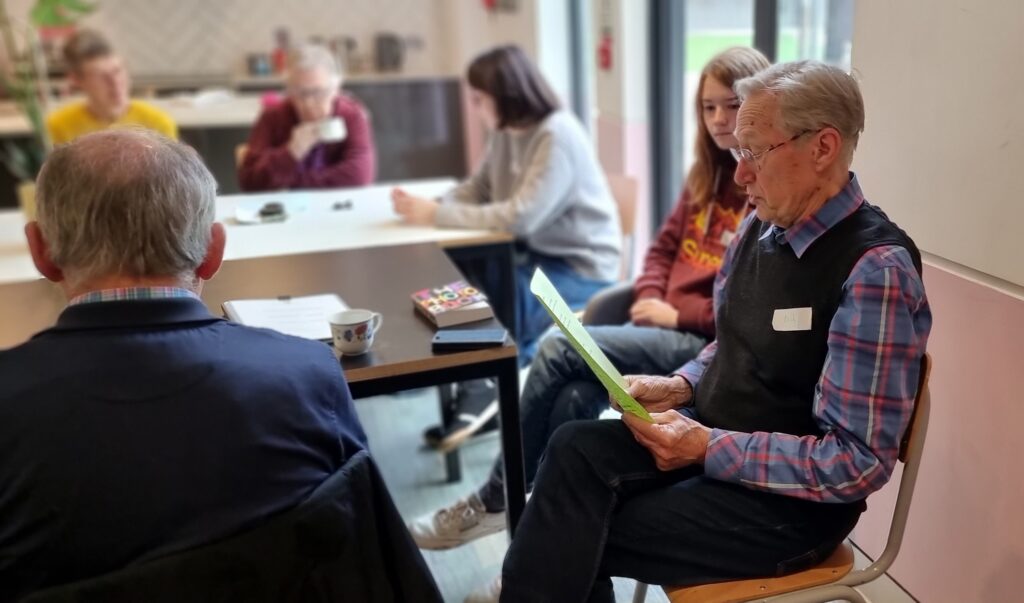
Rasa started with Bright Shadow in 2011 as an independent evaluator completing her Master’s Degree. She stepped away for a time to finish her PhD and returned at the time that Clare Thomas took over as Executive Director. In 2022, due to her workload, she was going to step away as an evaluator but was instead asked to become a trustee of the organisation. From 2011, Rasa had always been involved in Bright Shadow in some way during the twelve years she has been a part of the organisation.
What is Bright Shadow and what do they do?
When asked to describe what Bright Shadow is and what it does, Rasa answered emphatically, “Bright Shadow is joy and it brings joy!”
“With my evaluator hat on and as someone that has worked in dementia care in a variety of settings for a long time, opportunities to engage in meaningful activities, an ability to express yourself and feel like you are contributing are few and far between for people living with dementia. There is a very strong narrative of deficit and not being able to do things. Bright Shadow bucks that trend by helping participants create and build value.
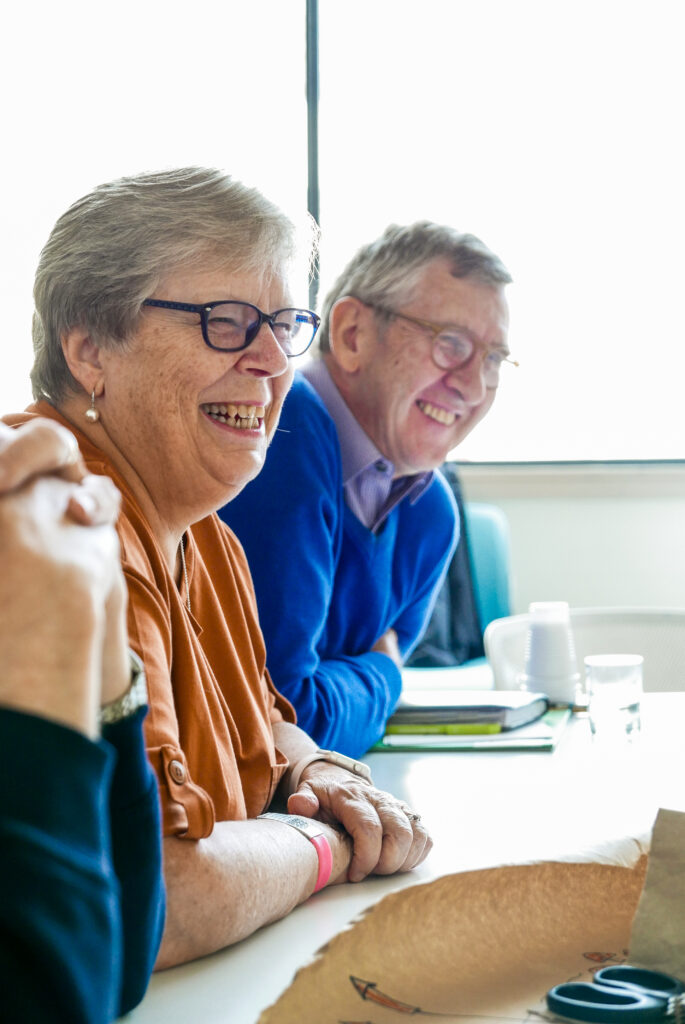
“Even though what Bright Shadow does and how they do it has changed over time, the running thread has been and still is joy. When I try to engage my colleagues in Bright Shadow’s fundraising activities, the way I talk about it comes from being in many settings where people with dementia are being supported. From what I have seen, none of those places bring the level of joy that Bright Shadow brings to participants and their carers. In a Zest workshop all you see are smiles. In a world where dementia is seen through a very negative lens, the ability to do something, the ability to create, the ability to see yourself as creative, the ability to see yourself doing new things, these things carry a lot of power in my opinion.
“For a person with dementia and for their carers and those providing supporters, things are always changing and not for the better. It’s hard to not be negative when the person you care for is losing abilities or experiencing distress. To have the space where people can be playful together, but also witness the ability to create and do new things, it helps bring positivity back into their lives.
“A challenge has always been persuading those who fund work in dementia, to see the necessity of our activities. Because of the progressive nature of the different dementias and their variation of how and when things change, things don’t get easier, not for the person and not for their care partner, so the joy created is not from a neutral point to a higher point but progressive from the lowest point to the highest point. With the joy comes a tremendous amount of growth for the person with dementia.”
What makes Bright Shadow stand out from other organisations in the field? What is the difference?
“Other places have activities, and you can produce activities that are cheaper, but the activities tend to be simple – a bingo game here, a cup of coffee and a chat. These are good but they, in my opinion, are the bare minimum and don’t give people enough credit. What sets Bright Shadow apart is the collaboration with professional artists and the level of professionalism they bring to the work. It says, people with dementia can be creators and look at what they have created; they can have social value. Bringing the artists in for focused projects and making the arts more dementia friendly is what makes Bright Shadow different. The degree of investment and the goal of not providing the bare minimum as a way of engaging people with dementia. Bringing in skilled artists also says a lot about the value Bright Shadow has for its participants and it says a lot about the ethos of creating with, not doing to.”
What is the impact of the work of Bright Shadow?
“It’s not one thing. It’s definitely not one thing, Bright Shadow brings a few different impacts to the participants. It’s about helping people with dementia see their strengths, helping people be surprised by what they can do in spite of their dementia diagnosis. It’s also about wellbeing and the change in participants’ wellbeing from the beginning to the end of a session. It’s also about helping people make connections, it’s harder to measure, but we see people interacting, coming out of their shells. We hear stories from people who say coming to Bright Shadow helps them see dementia in a more positive light. They can go to other programmes and activities they engage in and feel more comfortable talking about having dementia. This is a big deal given the stigma that comes from having a dementia diagnosis.”
“The amount of joy that you see at Bright Shadow comes from the amount of skill involved and from people having something they created and can be really proud of. I participated in a holiday session that brought in a florist and created a Christmas mobile with one of the participants that has dementia. I helped her and she helped me and at the end, I thought to myself, “Damn, I didn’t know I could do that!” Imagine what the person with dementia felt at completing their mobile. That’s a lot.”
“What we (Bright Shadow) need to do a better job of is showcasing the art of our participants and seeing if this changes the perception of dementia within the community, not of the participants and their carers but the world at large.”
What would you tell a supporter interested in coming along to Bright Shadow with someone living with dementia? What advice would you give for a first timer?
“It’s about being playful and trying and not worrying about being silly. Don’t worry about doing something based on your usual standards of doing well. Because of the way dementia affects some people, they may be more playful and less inhibited than they were before developing dementia. It’s usually the carer that holds back or initially finds the playfulness uncomfortable. I would tell them to give it time.”
“To the carer, I say allow yourself and your person to be playful. You may not see a difference or change in the first session but give it time.”
What would be lost without Bright Shadow?
“Having the space that Bright Shadow creates and the joy it brings would be lost. For many people it is the highlight of their week. It brings a reprieve, a chance to connect, a chance to be sociable. It gives people the opportunity to not focus on deficit and having to manage everyday. It gives them an opportunity to have fun and just be. The world would be a worse place without Bright Shadow and what it provides. There is really nothing else like it that I have come across, I haven’t seen everything but from what I have seen it’s unique. It’s unique for Kent. The variety of programming that Bright Shadow has is an asset. They are responsive to the community and the participants.”