Zest at Home: An Artist's Perspective
David Leahy, Musician and Dancer, reflects on his creative practice in Zest at Home sessions, and the creative and social value of investing in these bespoke, 1-1 sessions with people living with dementia.
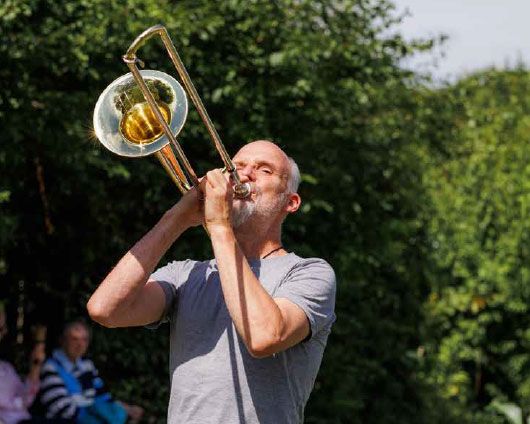 image credit: Jen Holland
After saying hello and sitting down, I wait. I sense that S may not have slept well last night as he is shielding his eyes with one hand. After a couple minutes, I play a single note on the bass guitar and let it ring. Slowly, S lifts his head and opens one eye. Peering through his fingers he scrutinises me. Unconsciously he makes a small gesture with his hand, I pause before responding with a hand gesture of my own that reflects the same tone and quality. Seeing the intentionality of my response, a knowing smile spreads across his face. Our session has begun.
Performance in the everyday
As an improviser, I am used to waiting for something to appear, while at the same time trusting that something will happen. This is what constitutes the essence of a performance. A performance is not just about playing to an audience, but rather it is about communicating something that matters to someone else. A performance therefore does not exist just on a stage but can occur anywhere and at any time. This is where my work for Bright Shadow begins, in finding a quality of performance in the everyday.
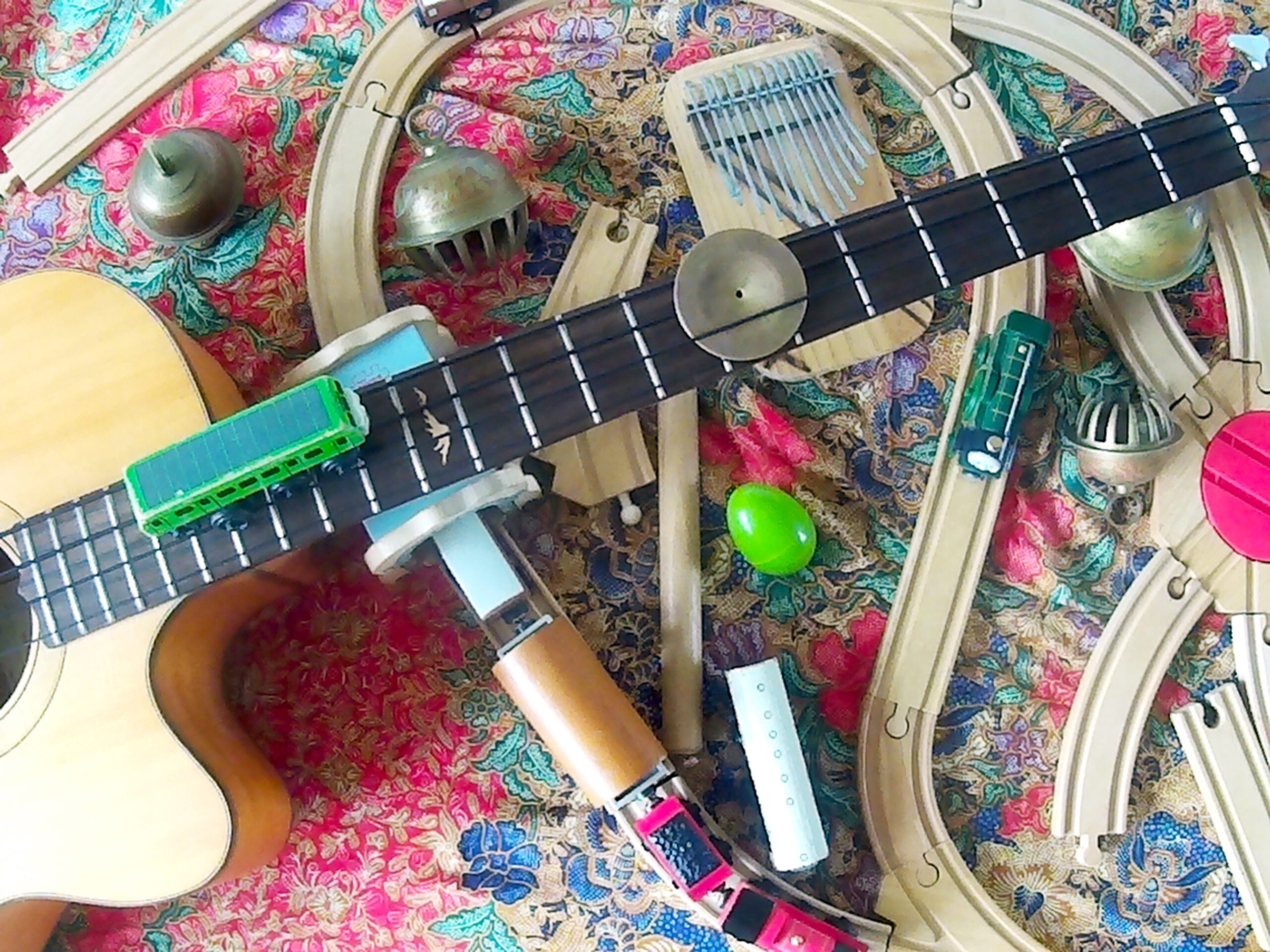
An important feature of my sessions with S were conversations about trains, spurred on by his long career overseeing large infrastructure projects. The conversation regularly took on a business-like tone as we continued to assemble and dismantle the pieces of wooden railway in front of us. Occasionally, I would place a guitar or drum on top of our construction site for S to play. He may balance trains or tracks on the strings, and we would listen to what sounds emerge. Together we would discover subtle little sounds that draw us both into deeper listening. Regularly, I would underscore S’s voice on the bass guitar, matching the pulse of his speaking with a bass line. He would then pick up the rhythm and tap along before starting to whistle a melody. I would then take up his melody and start to sing a small refrain. In this way, our musical journey would meander in, around, and through our conversation.
The art of listening
The act of listening remains the most crucial ingredient within my performance practice. It is through this quality of deep listening that I find the right action, sound, and/or words to say. Within a therapeutic context, this sensitivity to the moment can be found in the way that Dan Hughes (2009) talks about the importance of fostering a quality of intersubjectivity. Where playfulness, acceptance, curiosity, and empathy (PACE) combine to communicate the shared value of the relationship and the importance of ensuring each person’s autonomy within the discursive process.
This same openness can be found across artistic practices, where the practice is allowed to go where it needs to go, even across creative disciplines. This remains one of the strongest elements of the work of Bright Shadow, as it engages with a wide array of artists that all respond to living with dementia in their own unique way. As a dancer, I am constantly amazed at how the muscle memory associated with very complex physical activities can remain intact even after dementia has taken a firm hold of other aspects of daily life.
Jamming with D
My Zest at Home sessions with D took the form of a musical jam. An accomplished pianist, D and I would allow one song to segue into the next. In this way, we could easily touch on thirty tunes in one session, only stopping when one of us would get stuck, unable to recall the chord changes to a song’s middle eight.
“How does it go again?”
“Oh, I can’t remember.”
”Neither can I.” We would both end up laughing.
Connecting to ourselves and one another
Tom Kitwood explains that when the individual is no longer able to maintain their sense of identity themselves, it becomes the job of those around them to support their connection to who they are. He states that “identity remains intact, because others hold it in place” (Kitwood, 1997, p. 69). This was the basis of two sets of Zest at Home sessions that I conducted during the Covid-19 pandemic lockdown period.
A had moved into a care home just before the lockdowns began. As a result of being in a new environment and separated from his wife, who was unable to visit, his dementia symptoms quickly worsened and naturally everyone in the family was in a state of great distress. In response to this situation, we convened A, supported by a care worker in the care home, and his wife, C, who had never used video conferencing before. Our online sessions focused on the retelling of stories of their past together, underscored by improvised music. This quickly expanded to stories also being shared by their two adult children who lived many miles away. The resulting DVD that combined these stories, along with family photos and the original music, composed to reflect his musical tastes, was sent to the care home to further reinforce A’s recollections of his past.
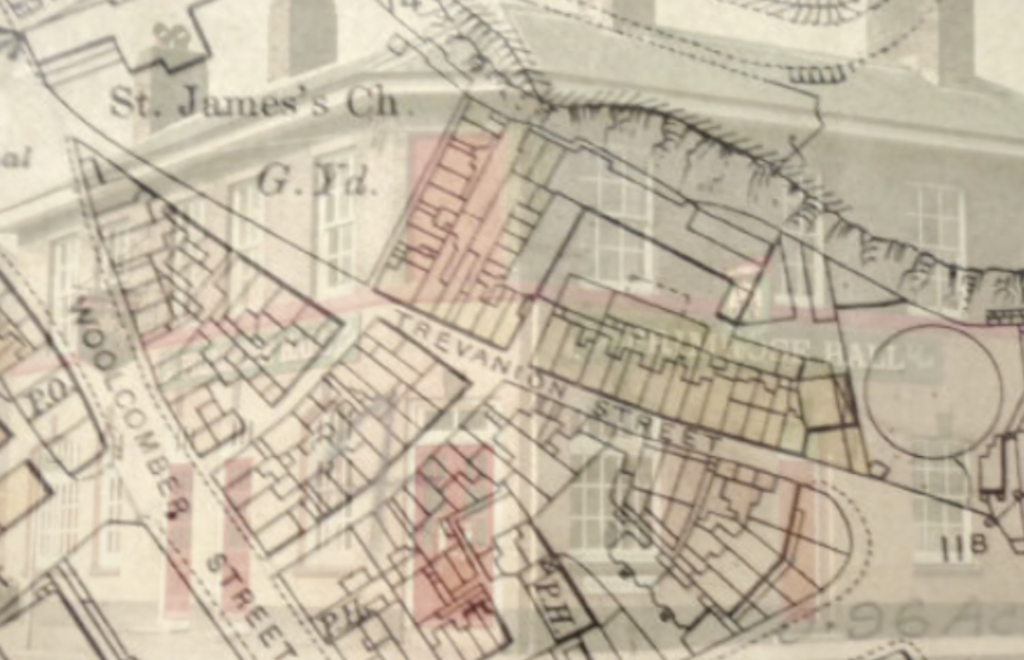
A similar approach to reinforcing one’s sense of personhood occurred with M, who was in the late stages of dementia. M had previously attended our Zest groups, but due to personal circumstances and digital poverty had been very hard to reach in the early stages of the pandemic and his health had declined rapidly. M had a keen interest in Dover’s local history, so using music and conversation, whispered by M from his bed via his carer to me online, we co-created a DVD, with original music and images of Dover’s past, providing a starting point for conversations between M and his carers until the end of his life.
The time to create
While the main Zest programme offers those living with dementia the chance to come together, to socialise, and to co-create something that regularly leads to moments of celebration, the Zest at Home programme provides an opportunity for more special, unique, and intimate interactions focused very specifically on the needs and interests of one person. It is within this 1 to 1 interaction that we, as artists, have an opportunity to share what is most important about what we do, which is time. Time spent being open to new ideas and ways of seeing ourselves and the world around us differently. The Zest at Home programme touches on a level of connection that we cannot readily enter into during the larger Zest group sessions. It is therefore a very important counterpart to the main Zest programme, allowing for a depth of connection while also bringing the essence of Zest into the homes of those that need it most.